The practice of test cutting was first popularized in the Edo period (17th century) for testing the quality of Japanese swords. Today, it has evolved into a martial art in its own right, focusing on demonstrating the practitioner’s skill with a sword.
What is sword test cutting?
Test cutting (known in Japanese as Tameshigiri) is a Japanese martial art. It is a way of checking how good your sword or cutting technique is, and of identifying what errors you need to correct.
What is the history of test cutting?
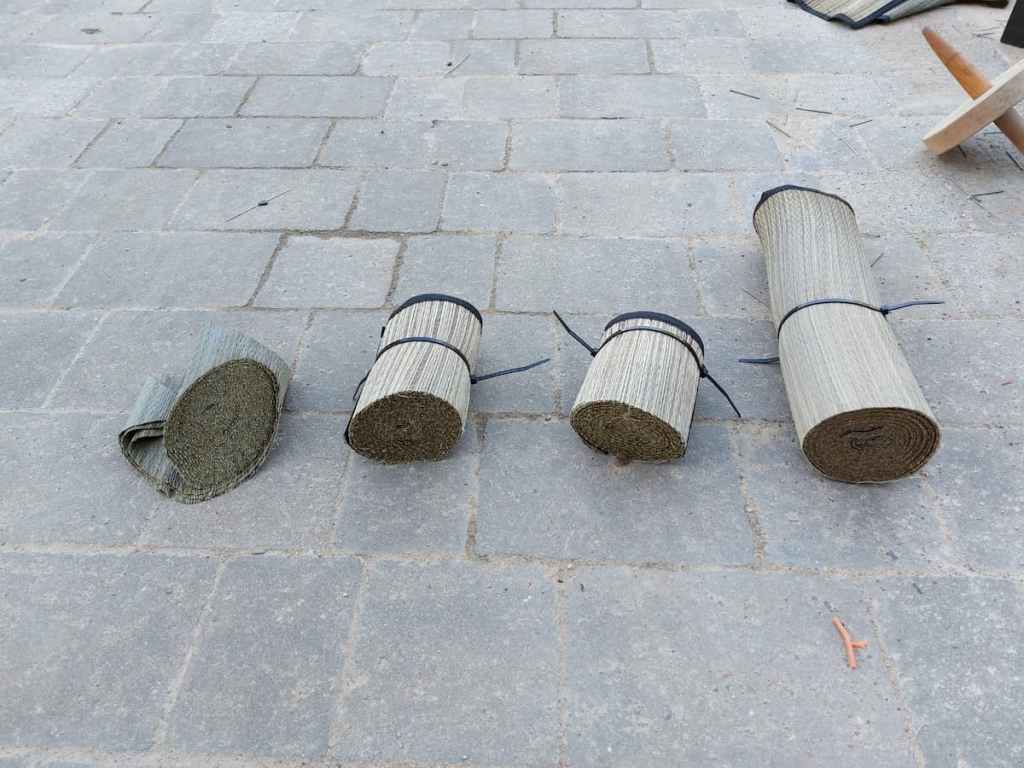
Tameshigiri has a gruesome history. The practice was first carried out on dead bodies, and alarmingly, on criminals and prisoners of war. Today, thankfully, it is typically done cutting a roll of 3 or more tatami (reed) mats.
How do you prepare mats for test cutting?
To make the mats the correct texture, they are rolled up and soaked for a couple of days before being allowed to drain. They are then set vertically on a stand. The soaked rolls of reed mats are supposed to give a similar resistance to being cut as a human limb. Sometimes green bamboo is used in the centre to have the effect of bone, but these are difficult to source in the UK.
How to test cut a sword
The basic cuts are:
- Vertically downwards
- Diagonally down left and right
- Horizontally left and right
- Diagonally up left and right.
The medieval Japanese were, like the Victorian British, insistent that everyone is right handed. Consequently, the katana (Samurai sword) is always held in your right hand.
A clean cut requires:
- The blade and the swing to be perfectly in line.
- The right amount of “slice”. A sharp sword will not cut through the roll unless there is a slicing action. Too much slice and only the front of the roll will be cut. Too little slice and the sword will not cut through the roll, but get stuck in it.
- Sufficient speed is generated in the swing.
Common mistakes in technique that test cutting exposes are:
- Not cutting all the way through the roll: This can be simply that not enough speed has been generated with the swing, or that there is too much or too little slice to the cut.
- The blade and the swing are not perfectly in line so the cut through the roll curves like a ski slope, rather than being flat.
 Bujinkan Cotswold Dojo Ninjutsu